Sparling work update

8th Apr 2026
by Jamie Ribbens
Sparling, also known as European smelt, is one of the rarest fish in Scotland and they are only known to be present in three Scottish rivers. The River Cree supports a sparling population.
Background
Historical over fishing, pollution and barrier building have removed populations from other Solway Rivers including the Annan, Bladnoch, Dee, Esk, Fleet, Lochar Water, Nith and the Urr. They are protected under the Wildlife Countryside Act 1981 and are also included in the UK and Dumfries and Galloway Biodiversity Action Plan Priority Species list. The Lower Cree is a designated SSSI to protect the vital spawning grounds for this rare fish.
GFT survey and monitor the Cree Sparling population when we can over the years. This year, with funding from Heritage Lottery Fund as part of the Solway Coast and Marine Project SCAMP Landscape Connections, GFT has been able to upscale previous studies and we hope to be able to deliver a long term monitoring project for this fascinating fish. This work included an initial Site Condition Monitoring study during Spring 2026.
Pre-spawning Checks
This involved collecting environmental data such as water temperature daily from the 1st of February. The sum of the water temperatures is added together to give degree days which are included in a formula that predicts when spawning will start.
This year, the impact of climate change has been particularly noticeable with bad weather, inconsistent water temperatures and high flows and it was difficult to know whether the prediction would be accurate when considering the variables.
After 100 degree days, daily fish predator counts and egg checks were started. The predator counts look for predatory birds such as cormorants and goosanders, but predatory mammals are also counted. Over this period the river flows were very high and despite checking at low tide, no predators were spotted and the egg checks were similarly disappointing.
Spawning and Site Condition Monitoring
Sparling are weak swimmers and use the high tide to push them into freshwater to spawn.
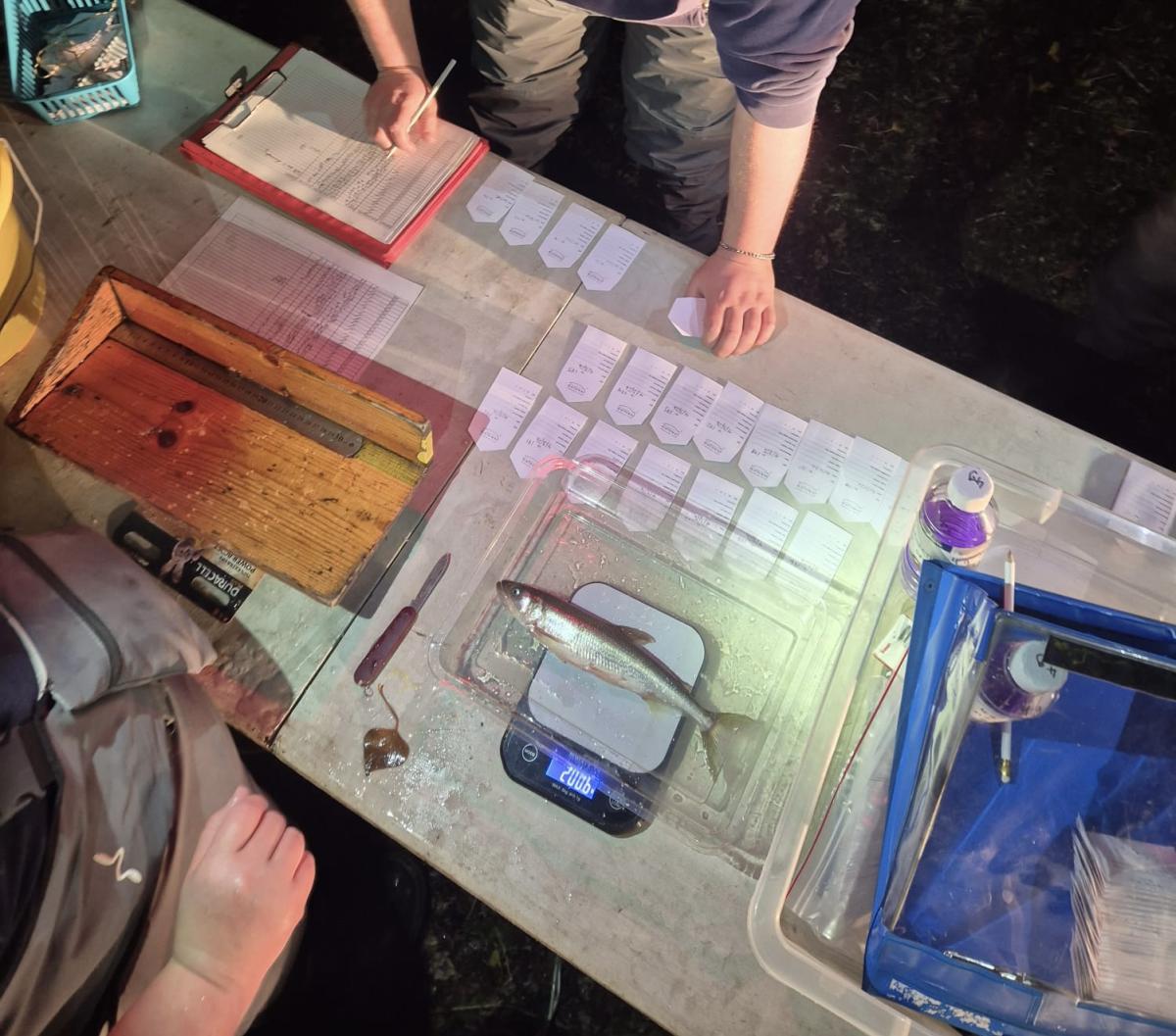
3rd March was the highest spring tide due to the full moon, this was also the day predicted by the formula for sparling to start spawning. The surrounding days were very wet and the river was high so it was wonderful, but unusual, to find good numbers of sparling spawning during the day high tide. Due to the unpredictability of the weather and tides, all available GFT staff headed to the river to carefully capture a sample of fish. The sparling were only present for a few hours before heading back to sea. So sampling continued that night on the next high tide. Half of the team headed down to the river with keep nets to catch sparling, while the rest of the team prepared the processing equipment under the A75 road bridge. The sample size required for Site Condition Monitoring SCM is 200 fish - these fish can be sampled and released again back to the river to continue spawning.
The purpose of SCM is to determine the health of the species population within a site. This can be used to calculate whether the population is likely to maintain itself in the medium and long term under the current conditions. SCM of the Sparling population involves the capture of 200 fish, with each individual measured, weighed and a scale sample taken. Sex, disease, predator damage and gravidity are all noted. The fish are then returned safely back to the river. This year’s data can be used to work out the condition factor of each fish to check on their size and health, and the age class distribution within the population. This is all important information to have regarding managing this vulnerable species which has been driven to extinction in 12 South Scotland rivers.
Post-spawning Checks
It was great that the sample of 200 fish were collected relatively easily in the first 24 hours of the spawning cycle. Over the following days, it was clear that spawning continued on further night high tides, with fresh otter kills found a week later under the A75 road bridge.
GFT staff completed further egg checks to identify the upper limit of the spawning reach used in 2026 and the main spawning areas used. Regular checks are on-going to record the hatch date of these eggs and to check for survival. Once hatched, the juveniles will be swept out to the estuary to feed and grow.
Future Plans
The data collected during the 2026 spawning run will be processed to determine the condition of the population, the final Site Condition Monitoring report will be available to download from the SCAMP page on the GFT website in the near future.
A key objective of the SCAMP Rare Fish project is to understand the range and presence of sparling, Allis shad and Twaite shad across the Solway, we plan to use eDNA analysis to assess the current presence or absence in other local rivers. There is an opportunity to consider how coastal and estuarine habitat restoration through SCAMP could improve these rare fish populations at critical periods of their lifecycle. Our ambition is to increase the numbers and distribution of these fascinating and rare fish and to help local communities appreciate the natural and cultural importance of them.
Further Information
Latest News
King of fish secures win for junior angler
For the second year running, a junior angler has secured "Best Fish" at our annual Kirkcowan Angling Competition, which finally got underway on Saturday 27th September
Why do GFT go electrofishing.
Electrofishing is an effective and safe technique used to catch juvenile fish in freshwater habitats.
GFT 6 month internship available
A paid internship is available from October 2025 for 6 months to work with Galloway Fisheries Trust on our River Annan Restoration Project.